Few aspects of real estate generated as much confusion — and emotion — as bidding wars. From the outside, they sometimes appeared chaotic or unpredictable. But from within the process, there were patterns, expectations, and a rhythm that shaped how those days unfolded. To truly understand that period, it helps to walk through what offer night actually felt like — not just how it worked on paper, but how it unfolded moment by moment for buyers, sellers, and the agents guiding them.
The bidding war strategy began to emerge in Guelph around 2014, when demand started to consistently outpace supply. It became apparent that by listing a property at a deliberately low price, a wide net could be cast to attract as many interested buyers as possible.Even buyers whose budgets aligned with the artificially low list price often became emotionally invested. Once engaged, many stretched beyond their original comfort levels, driving the strongest offers higher.Over time, this approach gained traction and became an accepted way of bringing a property to market.
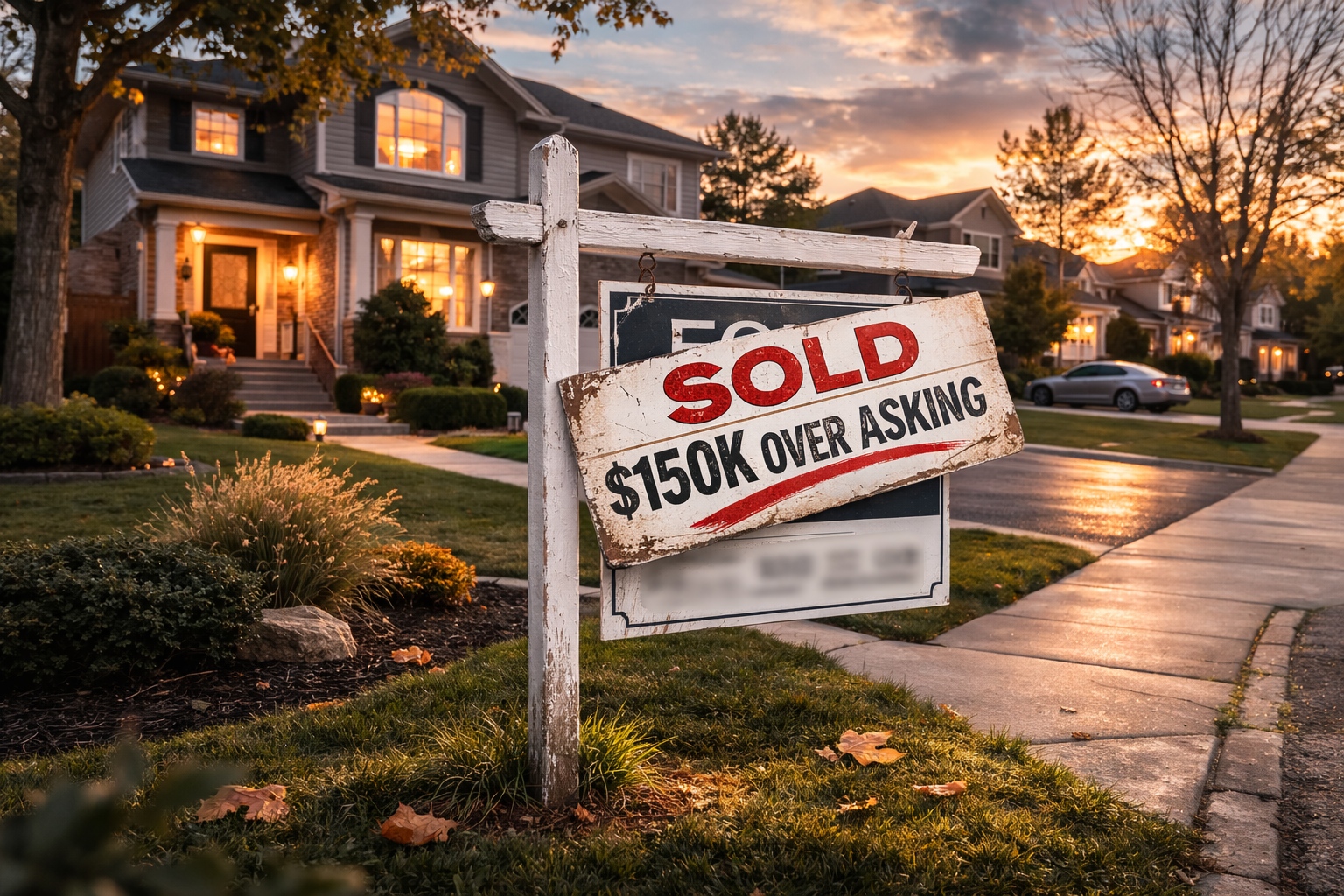
As competition intensified, pricing low to generate multiple offers became increasingly common. Buyers quickly learned that list price was often an entry point rather than a reflection of value.Between 2019 and March 2022, this strategy was used on almost every listing. Homes routinely sold $100,000 to $150,000 or more above asking. Sellers came to expect strong results, often hoping to match or exceed the outcomes they heard about from neighbours or friends.Negotiation, in the traditional sense, largely disappeared. Sellers dictated timelines and terms. Offers were expected to be firm.Buyers adapted quickly. They accepted leased furnace and air conditioning contracts that in previous markets would have been negotiated or bought out. They arranged bridge financing rather than negotiating closing dates. They removed every possible condition to remain competitive.It was a fast-moving environment where hesitation often meant losing the opportunity altogether.While Realtors were often blamed for pushing prices higher, listing agents are legally required to act in their clients’ best interests and pursue the strategy most likely to achieve the strongest result within the legal framework of real estate legislation. Failing to do so could expose an agent not only to professional consequences but to civil liability as well.
For buyers, offer night carried a weight that is difficult to describe unless you lived through it.After preparing offers — sometimes stretching finances and leaning on family support — buyers waited. Phones stayed close. Conversations paused. Everyone knew several other families were hoping for the same outcome.Buyers submitted letters with their offers, hoping to create a personal connection. The opportunity to include conditions such as financing or inspection disappeared entirely during this period. High deposits, short closing dates, and unconditional offers became the norm.After hours of waiting, the buyer’s agent would make the call. Often, buyers heard the words they had come to expect — they had lost again.Many buyers lost six, seven, eight or more properties, tweaking their offers each time until they finally secured a home.It was an extremely emotional time for both buyers and agents — disappointment, fatigue, and determination all coexisting — regrouping the next day to try again.The reality was that buyers made offers based on what they could afford, not necessarily on what they believed the home was worth, because each sale reset expectations for the next.
For sellers, offer day began very differently.They woke that morning excited, often hopeful that their result might mirror stories they had heard — $100,000 or $150,000 over asking was no longer unusual.Throughout the day they waited for updates.Ten o’clock — nothing.Noon — still quiet.Two o’clock — still waiting.With offer presentation set for late afternoon, even the listing agent wondered whether offers would materialize.Then, often around four o’clock, the tone shifted. Phones rang. Offers began arriving one by one in the inbox, each stronger than the last.Once all offers were collected, the agent met with the sellers to review them in order of submission. Offers with conditions were quickly set aside as unlikely to compete.One by one, offers were read aloud. Sellers focused on price and closing date. With most offers firm, there was often little else to consider.The strongest offers were sometimes described as “one-liners” — straightforward commitments centred on price and timing.Typically, attention narrowed to the top few offers. If one stood clearly above the rest, it was accepted. If several were close, the listing agent contacted competing agents and invited improvements.Buyers often increased their offers — sometimes by a few thousand dollars, sometimes by tens of thousands. In some cases, offers were sent back two or three times, in what became known as “rounds,” until sellers felt the highest price had been achieved.When the decision was finally made, sellers celebrated. The agent shared in the relief. The successful buyer received the call.Everyone was happy.And exhausted.
In more than three decades in real estate, I had never experienced a market like that. It was an exciting time to represent sellers and an extraordinarily challenging time to support buyers.Many of the traditional guardrails — including property appraisals — carried less weight, as values often rose between offer acceptance and closing.
The full impact of that period is still unfolding. With property values adjusting in some segments, interest rates rising, and mortgages renewing at higher costs, the effects of those years are becoming more visible.The combination of rapid price growth, fear of missing out, and historically low borrowing costs reshaped expectations in ways that may take time to fully settle.Markets move in cycles, but the experiences of that period continue to influence decisions today. For many, those years were not just about buying or selling a home — they were about navigating uncertainty, making difficult decisions, and learning just how personal real estate can be.