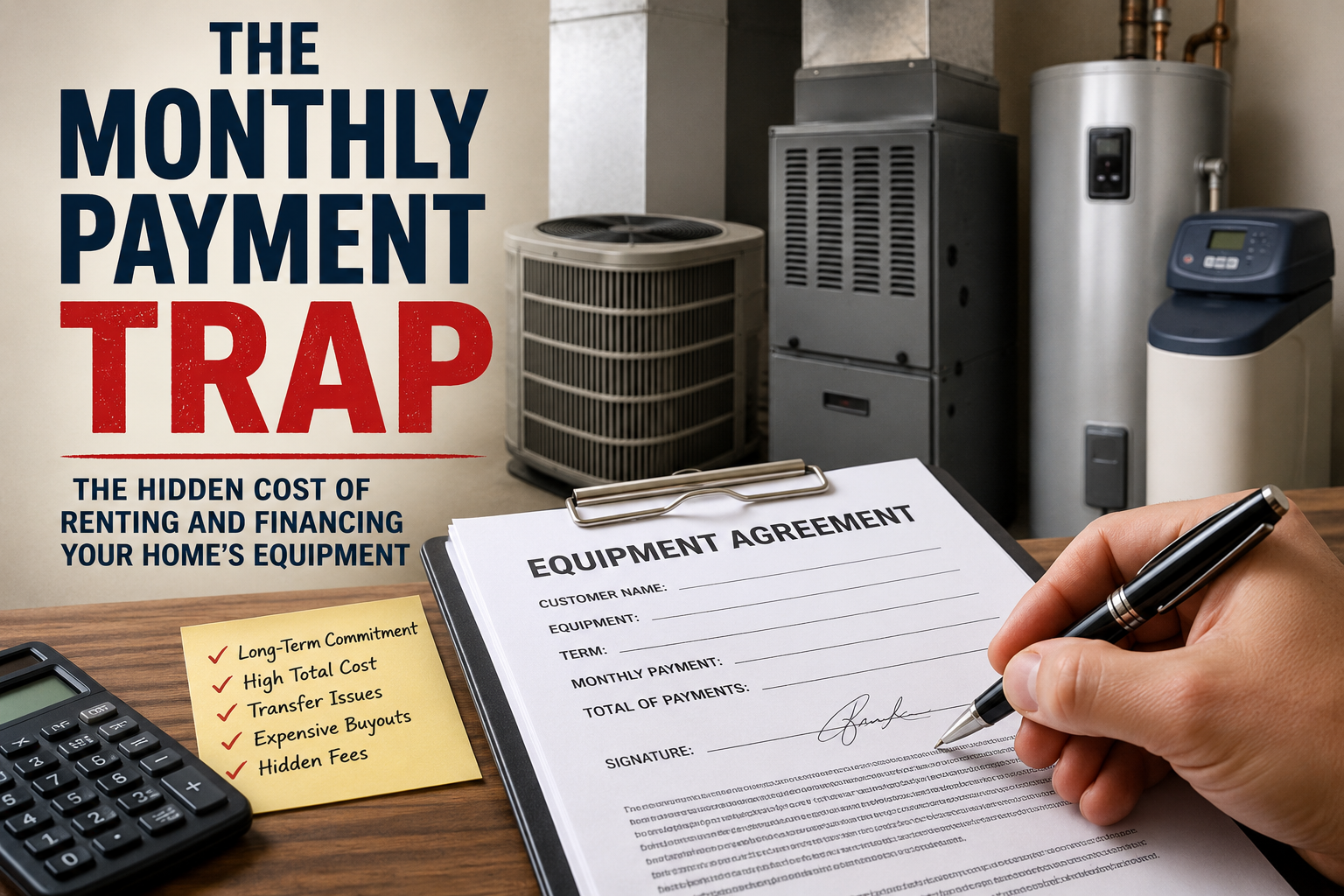
What Homeowners Need to Know Before Renting or Financing HVAC Equipment.
It usually starts with a simple and attractive proposition.Your furnace is aging. Your air conditioner needs replacing. Maybe the water heater or water softener is nearing the end of its life. A company offers to install new equipment for one manageable monthly payment, with no large upfront cost and no need to worry about repairs or replacement.It sounds convenient.But after reviewing several of these agreements during real estate transactions, I have learned that the monthly payment can be the least important number in the contract.The questions homeowners should be asking are: What am I actually signing? Who is the agreement really with? How long will I be paying? What will I have paid by the end? What happens when the equipment fails? And what will it cost me to get out of the contract when I sell my home?The answers can be surprising.
The Perpetual Rental
In one transaction, I reviewed a rental agreement for a furnace and central air-conditioning package.The starting payment was $158.19 per month, including tax. The agreement estimated the retail value of the equipment at $13,060.54 and the total payments over an assumed 15-year equipment life at $28,473.97.After paying almost $28,500, the homeowner still would not automatically own the equipment.The contract was very clear: this was a rental, not rent-to-own. The minimum term was seven years, after which the agreement automatically continued for an indefinite period unless terminated under the terms of the contract. The monthly payment was also subject to future increases under the agreement.This is the appeal of the perpetual rental: no large purchase price today, predictable monthly payments and the promise that someone else will worry about the equipment.But convenience has a cost.And despite what homeowners may be told when these agreements are sold, in my experience, buyers do not consider expensive rental equipment an attractive feature of a home. Many do not want to assume someone else’s long-term contract and will instead negotiate for the seller to buy it out.That is often when the homeowner discovers the real cost of the agreement.You May Not Be Signing With the Company at Your Door
Another concern is the distinction between the company selling and installing the equipment and the company that actually holds the contract.A homeowner may deal entirely with an HVAC company. That company recommends the equipment, suggests bundling the furnace with the air conditioner, water heater or water softener, installs everything and focuses the conversation on an affordable monthly payment.But the long-term agreement may actually be with a separate finance company.That distinction matters.The homeowner may believe they have arranged a simple equipment rental with the local installer when, in fact, they have entered into a long-term financial obligation with another company.In one property transaction, my buyers were asked to assume three separate equipment agreements covering a furnace, water heater and water softener.The water heater agreement alone had a 12-year initial term at $28.24 per month, with total contractual payments of approximately $4,948 against a stated equipment value of $1,875 before tax.The water softener agreement had a 10-year initial term at $33.89 per month, representing estimated payments of approximately $4,067 during the initial term. Its purchase option was based on estimated fair market value rather than a simple predetermined nominal buyout.The property also had a separate furnace agreement with an approximately $18,000 payout.We examined the agreements. My buyers declined to assume any of them.The seller ultimately paid out all three contracts in order to complete the sale.What Happens If the Equipment Doesn't Last as Long as the Contract?
While reviewing the 12-year water heater agreement, I encountered another problem.I could not find anything in the contract that clearly explained what would happen if the water heater failed before the agreement ended. The contract analysis itself identified the replacement provisions as unclear.So I called the company.Eventually, I escalated the question to a manager and asked a very simple question: What happens if the water heater fails in year 10 of a 12-year contract?I was told that the company would install a replacement without an upfront equipment charge—but the homeowner would begin a new 12-year agreement.Think about that.A homeowner could pay for ten years, have the equipment fail, receive a replacement and start another 12-year commitment.The promise that you never have to worry about replacing the equipment sounds very different once you understand that the contractual clock may start all over again.When a “Rental” Is Actually a Loan
Perhaps the most concerning example I have encountered involved a homeowner who believed she was renting a water softener.She wasn't.The arrangement was financing: 3% interest for the first three years, increasing to 19.99% afterward, with a 25-year term.A colleague involved in the real estate transaction had the agreement reviewed by a lawyer in an effort to find a way out of the contract. Ultimately, the seller had to pay it out to complete the sale.A 25-year financial obligation for a piece of household equipment should cause any homeowner to ask serious questions.How long is the equipment realistically expected to last? What is its actual cash purchase price? What is the total cost of borrowing over the full term? Is the interest rate fixed or introductory? And what happens if the home is sold long before the financing term ends?The fact that the monthly payment is affordable does not answer any of those questions.The Problem Often Appears When You Sell
These agreements can sit quietly in the background for years.The homeowner pays the monthly bill. The equipment operates. Life goes on.Then the house is listed for sale.That is when the agreement is examined by Realtors, buyers and lawyers. The questions that may not have been asked when the equipment was installed suddenly become very important.Who owns the equipment?Is this a rental or a loan?Can the agreement be transferred?Does the buyer want to assume it?What is the current payout?What has the homeowner already paid?What will it cost to get out?In the transactions I have encountered, homeowners have often been surprised by the answers.There is also another side to this problem. Agreements of Purchase and Sale commonly provide for buyers to assume rental equipment, but buyers should not agree to take on a financial obligation they have never seen or reviewed.Before agreeing to assume any rented or financed equipment, the buyer’s Realtor should obtain copies of the actual contracts for review. If they are not available before the offer is submitted, the offer should be made conditional on the buyer reviewing and accepting the agreements.The monthly payment alone is not enough information. Buyers need to understand the remaining term, future payment increases, ownership and buyout provisions, replacement terms and what happens when they eventually sell the property themselves.What appears to be a small monthly rental can represent a significant long-term financial obligation.Read the Contract, Not the Monthly Payment
I am not suggesting that every equipment rental or financing agreement is inappropriate for every homeowner. There may be circumstances where someone knowingly chooses convenience over the lowest possible long-term cost.The problem is making that decision without understanding what is actually being signed.Before agreeing to any monthly payment for a furnace, air conditioner, water heater or water softener, ask for the following information in writing:- the cash purchase price of the equipment, including installation;
- whether the agreement is a rental, lease or loan;
- the name of the company that will actually hold the contract;
- the full term of the agreement;
- the interest rate and whether it can change;
- the total cost over the full term;
- the buyout or payout formula;
- what happens if the equipment fails before the contract ends;
- whether replacement equipment starts a new agreement; and
- exactly what happens to the contract when the home is sold.